Residential bike storage: why the waiting lists run for years, and what actually shortens them
Af Tim de Booij den 3. august 2026
Most advice about storing a bike assumes you have somewhere to put it. A shed, a hallway, a spare corner of a garage. Plenty of people don't. If you live in a flat or a narrow terraced house, the bike either goes up the stairs every night or it stays out on the street, and the street is where bikes get stolen.
The usual answer to that is shared residential storage: a small on-street unit that holds a handful of bikes, rented by the people who live nearby. In the UK these are the cycle hangars you now see bolted onto the road. In the Netherlands they're buurtstallingen and fietstrommels, the enclosed communal units tucked into residential streets. Same idea in both places, and the same problem. There aren't enough of them, and the wait to get in is long.
How long? In London the combined waiting list for secure hangar spaces passed 60,000 people last year, with Southwark alone counting more than 8,000 residents queuing for a spot. In Utrecht the council's own figures put the wait for a place in a fietstrommel at up to nine years, and up to four and a half years for a neighbourhood shed. These aren't edge cases. For a lot of people in a dense city, that queue is just what trying to store a bike properly looks like.
Building more units is only half the answer
The obvious response is to install more, and councils are doing exactly that. Southwark approved millions of pounds for thousands of extra hangar spaces, and Dutch cities keep adding units year after year. It helps. It also doesn't close the gap on its own.
The reason is that supply isn't the only thing rationing these spaces. A good chunk of the delay isn't a shortage of steel on the pavement, it's how the existing units get run. Most residential storage is still managed the way it always was: a physical key handed over in person, a waiting list kept in a spreadsheet or on paper, and no real way to see which spaces are actually being used day to day. When someone moves away or simply stops cycling, their key can sit in a drawer for months before anyone reclaims the spot. On the list the unit reads as full. On the street it's half empty.
That's the part worth sitting with. Some of the people stuck near the bottom of a nine-year list are waiting on spaces that aren't genuinely occupied, just never turned over.
Access and admin are the real bottleneck
Keys are the quiet villain here. A key has to be cut, handed out, chased up when someone leaves, and replaced when it's lost. Every one of those steps needs a person, and that person is usually stretched across a whole city of units. So turnover is slow by design. Nobody is doing anything wrong, the process just leaks time at every handover.
The waiting list has the same weakness. If it lives in a spreadsheet, nobody in the queue can see where they stand, and the operator has to phone round to fill each opening. Payments and renewals add another layer of manual work on top. None of it is complicated. There's just a lot of it, and it all sits on someone's desk.
So when a resident asks why the wait is nine years, the honest answer is rarely "we have no units." It's closer to "we can't move people through the ones we have fast enough."
What smart management changes
This is the side of the problem ParkMyBike is built for. The bike garages we work with hold four to six bikes each, which is the same footprint as a hangar or a fietstrommel, but the access and the admin move into software.
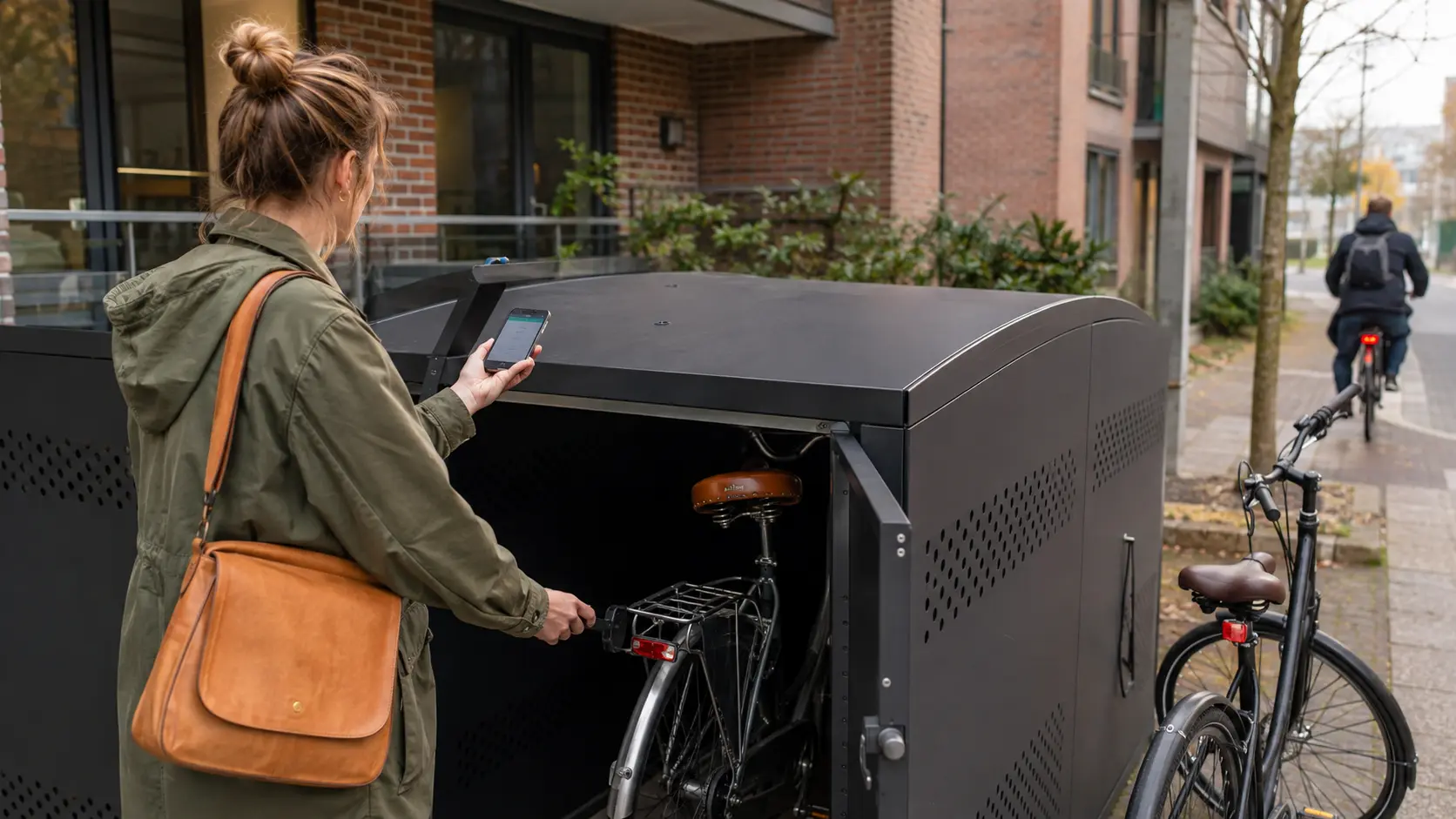
Instead of a key, residents find, reserve and open their space from the app on their phone. When someone moves out, the space frees up in the system straight away, so it can go to the next person without a key ever changing hands. The waiting list is digital: people join it, subscribe and manage their own spot from the app, while the operator sees the whole picture from one dashboard, including which spaces are actually in use. Payments and renewals run through the same place, so a space that goes quiet gets noticed and reassigned instead of sitting idle.
It also doesn't mean ripping out what's already on the street. The system works with existing locks as well as our own, so a council or a housing provider can make the units they already have smart rather than starting from scratch. We now run more than 300 subscription parking spaces across the Netherlands, Belgium, the UK and France, a fair share of them exactly this kind of small residential unit.
None of that magics up more parking on its own. But it means the units already installed do more work, spaces turn over in days instead of months, and the list actually moves. For someone who's been waiting years, that's the difference that matters.
Shorten the list without waiting for more steel
ParkMyBike turns secure, app-controlled bike lockers and garages into one smart system for cyclists, providers and manufacturers, with the waiting list, subscriptions and access all managed from a single dashboard.
Schedule a demo to see how ParkMyBike can help your city or housing provider get more out of the residential storage you already have, or find a spot near you at parkmybike.app.
Andre seneste blogindlæg
How to rent a bike locker (and what to check before you do)
Renting a secure bike locker is easier than it used to be, but a few details still decide whether it's worth it. Here's how the process works, what to look for, and where to find one.
How to park your bike safely at the station when theft keeps rising
Bike theft in the Netherlands has climbed for years, and stations are one of the worst spots. Here's what actually keeps a bike safe, and where an open rack falls short.